
[ad_1]
The federal government may once again have an opportunity to learn a painful lesson about rising debt prices and rising interest rates in an uncertain economy.
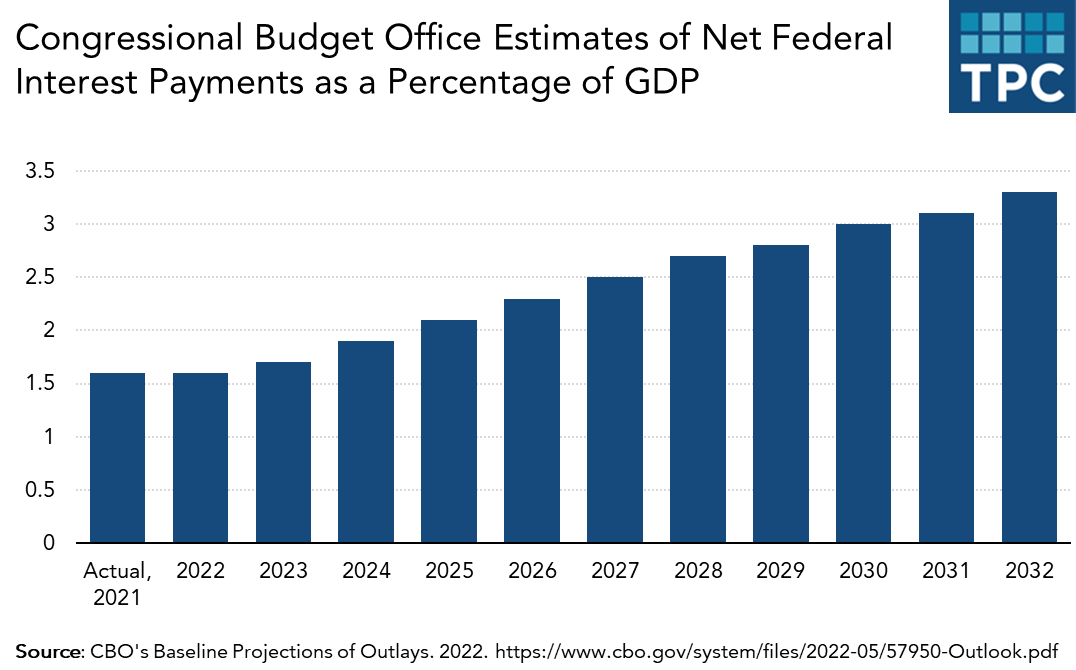
Congressional Budget Office, In the recently released budget and economic scenario, forecasts an increase in federal borrowing costs over the next decade. The CBO estimates that net interest as a share of gross domestic product (GDP) will nearly double over the next decade – from 1.6 percent to the decidedly inconvenient 3.3 percent. This is a significant increase from last year forecast of 2.7 percent.
$8 trillion in interest
In other words, the US government will spend more than $8 trillion in interest over the next decade, which is about 11 percent of its total spending. For context, in 2032, the Fed will pay more interest than any other federal program, except Social Security and Medicare. In the CBO projects, the federal government would pay $200 billion more in interest to be spent for national defense, assuming no change in policy.
Keep in mind that given the unpredictability of world events, these forecasts are more uncertain than usual. But also remember that the CBO’s forecast is likely to underestimate future debt because it is necessary to assume that Congress will not make any changes to the tax law or spending. But it is unlikely that lawmakers will allow the personal income tax deduction included in the Tax Cuts and Jobs Act (TCJA) to expire at the end of 2025. And the continuation of the decades of post-Cold War peace dividends may be equally impossible.
In recent years, there has been a historic increase in deficit and debt as a result of the 2017 TCJA and massive spending in response to the pandemic. But until recent months, interest rates still remained close to zero. Hence the impact on total government borrowing cost was muted.
not anymore.
3.3 percent of GDP
The net interest cost of CBO projects will increase from $352 billion in 2021 to $399 billion this year, or about 1.6 percent of GDP. But by 2032, interest costs will triple to $1.2 trillion, or 3.3 percent of GDP—1.3 percent more than their 50-year average. It is estimated that interest costs will grow at an annual rate of 12 percent over the next decade, while the economy will only grow at a rate of 4 percent annually.
Interest cost is a function of two main factors: the amount of outstanding debt and the interest rate the government must pay on that borrowing. In the medium term, the news is bad on both fronts.
Largely, but not entirely, due to large increases in Social Security and Medicare driven by the harsh aging of Baby Boomers, debt is projected to grow from 98 percent of GDP this year to 110 percent in 2032, which The highest ratio in American history. , By 2032, the CBO figures the national debt will reach $40 trillion.
The increased debt would add about 30 per cent to the interest cost. But rising interest rates would be a huge deal, which accounts for the remaining 70 percent increase in borrowing costs.
not what we are used to
The CBO projects 3-month Treasury bill rates will increase from an average of 0.05 percent in 2021 to 2.6 percent in 2025. It forecasts that the short-term rate will fall to 2.3 percent in 2028 and remain at that level until about 2032.
The CBO predicts that ten-year Treasury notes will follow the same pattern. It expects the rate on long bonds to rise from 1.3 percent in 2021 to 3.8 percent in 2028 and stabilize there by 2032.
Compared to recent memory, it is surprisingly high. But in reality, That’s almost half a century agoThe inflation and oil shocks of the 1970s and early 1980s sent rates to spectacularly high levels before beginning a protracted decline in the mid-1980s.
Will this happen? The CBO prepares its forecast in consultation with outside economists and produces as best a consensus forecast as you can find. But the economy is so uncertain, it is impossible to predict what will actually happen.
And the current rise in inflation and interest rates may only be temporary. Factors that many economists felt were responsible The decades-long secular decline still persists, including the aging of Western societies, the decline in globalization and productivity rates, and the growth of wealth inequality. In fact, deglobalization may be accelerated. And, in times of genuine uncertainty, investors can flock to the US Treasury as a safe investment, holding back rate hikes.
Nothing is known about it. But one thing seems certain: The federal government’s ability to borrow almost free of charge is gone, at least for now.
[ad_2]
Source link
