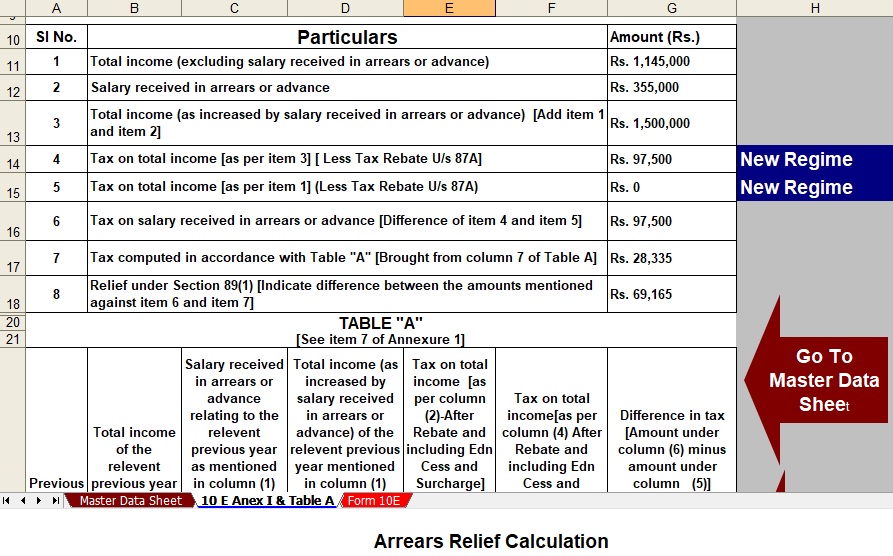
Sometimes, you receive salary arrears unexpectedly, right? However, that extra income may push you into a higher tax slab. Therefore, the Government created Section 89(1) and Income Tax Form 10E. Moreover, an automatic arrears relief calculator makes the process simple. Like a guiding map, the calculator walks you step-by-step, so you get the correct tax relief without fear of mistakes. Although the rules look technical, you can understand them easily and use them confidently.
Table of Contents
| Sr# | Headings |
| 1 | Understanding Salary Arrears |
| 2 | What Is Section 89(1)? |
| 3 | Why Form 10E Is Required |
| 4 | Benefits of Using a Calculator |
| 5 | Documents Needed |
| 6 | How Arrears Are Calculated |
| 7 | Step-by-Step Process |
| 8 | Old vs New Tax Regime Impact |
| 9 | Common Mistakes to Avoid |
| 10 | Online vs Offline Filing |
| 11 | Accuracy and Transparency |
| 12 | Example Calculation |
| 13 | Who Can Claim Relief |
| 14 | Tips for Employees |
| 15 | Conclusion |
1. Understanding Salary Arrears
You receive arrears when your employer revises your salary later. Consequently, the amount relates to past years. Therefore, you pay tax today, although the payment belongs to earlier periods. Moreover, you face a higher tax slab, because the arrears add to your current income. Eventually, you pay more tax now, even though the income originated in previous financial years. Furthermore, you handle arrears separately, so, you calculate the tax correctly. Overall, you benefit from understanding arrears clearly.
2. What Is Section 89(1)?
Section 89(1) provides tax relief when arrears increase your tax burden. Instead, you recalculate the tax for earlier years. Then, you compare the difference, and it becomes your relief. Consequently, you avoid extra tax, because the income belongs to older years. Additionally, Section 89(1) ensures fairness while keeping tax liability balanced. Ultimately, you save money.
3. Why Form 10E Is Required
You file Income Tax Form 10E to claim relief. Otherwise, the Income Tax Department denies the benefit. Therefore, you submit the form, so the department approves your claim. Additionally, the process remains transparent because the department verifies the calculation. Moreover, filing Form 10E makes the relief traceable, thus proving your eligibility. Finally, Form 10E supports your return, ensuring correctness.
4. Benefits of Using a Calculator
An automatic calculator:
-
instantly compares the tax of previous years,
-
automatically applies tax slabs,
-
avoids manual calculation errors,
-
and easily generates accurate results.
Thus, you save time and effort. Additionally, you reduce confusion. Furthermore, you increase accuracy. Therefore, using a calculator helps you feel confident.
5. Documents Needed
You need:
-
salary slips,
-
arrears breakup,
-
and tax returns from relevant years.
With these, the calculator works smoothly. Besides, documents support your submission. Moreover, proper paperwork prevents mistakes. Hence, you keep everything ready.
6. How Arrears Are Calculated
The calculator splits arrears into the correct financial years. Then, it computes tax on:
-
total income including arrears,
-
and total income excluding arrears.
Afterwards, you compare both values. Finally, the difference becomes your relief. Thus, the method clearly shows benefit. Consequently, you understand your tax savings.
7. Step-by-Step Process
You follow these steps:
-
Collect documents.
-
Enter year-wise arrears.
-
Select tax regime.
-
Review the calculated tax.
-
File Income Tax Form 10E.
-
Submit your tax return.
Therefore, you complete the process easily. Meanwhile, you ensure accuracy.
8. Old vs New Tax Regime Impact
Sometimes, the new regime offers lower taxes. However, this does not always happen. Therefore, the calculator compares both regimes. Then, you choose the better option. Additionally, you consider deductions and slabs. Thus, you file wisely.
9. Common Mistakes to Avoid
People often:
Hence, you re-check everything before filing. Moreover, you verify documents. Besides, you confirm tax slabs. Ultimately, you avoid errors.
10. Online vs Offline Filing
Online filing:
-
auto-fills details,
-
stores data,
-
and submits Form 10E securely.
However, offline filing requires more work. Additionally, offline mode increases manual entry. Therefore, online filing saves time. Furthermore, it reduces errors.
11. Accuracy and Transparency
The calculator shows each calculation step. Consequently, you understand how relief is computed. Moreover, the clear process builds trust. Besides, transparency ensures no hidden changes. Eventually, you feel confident with the result.
12. Example Calculation
Imagine you receive arrears from FY 2022-23. Previously, tax slabs were different. So, the calculator recalculates tax for that year, shows the lower value, and then offers relief today. Therefore, you pay correct tax now. Thus, the example proves the value of Section 89(1).
13. Who Can Claim Relief
Employees from:
-
government,
-
private companies,
-
and public sector undertakings
can claim relief when they receive arrears, bonus, or leave encashment linked to past years. Therefore, many employees benefit from this rule. Additionally, freelance professionals may apply in similar cases.
14. Tips for Employees
To claim correctly:
-
always use Income Tax Form 10E,
-
maintain year-wise documents,
-
and use an automatic calculator.
Thus, you avoid confusion later. Besides, you file smoothly. Moreover, you ensure accurate tax relief.
Conclusion
In short, the Automatic Arrears Relief Calculator U/s 89(1) simplifies a complex process. Instead of worrying, you enter details, file Income Tax Form 10E, and receive rightful relief. Ultimately, the calculator ensures fairness and accuracy for FY 2025-26. Therefore, you experience stress-free tax filing.
FAQs
1. What is Income Tax Form 10E used for?
You use it to claim tax relief on arrears under Section 89(1).
2. Can I get relief without filing Form 10E?
No, the department allows relief only when you submit Form 10E.
3. Who needs to file Form 10E?
Anyone who receives salary arrears or past income must file it.
4. Is the calculation automatic in the Excel tools?
Yes, most tools auto-apply slabs and generate relief values.
5. Can I choose between old and new regimes while claiming relief?
Yes, the calculator compares both regimes for maximum benefit.
Download Automated Income Tax Arrears Relief Calculator U/s 89(1) with Form 10E from the FY 2000-01 to FY 2025-26