
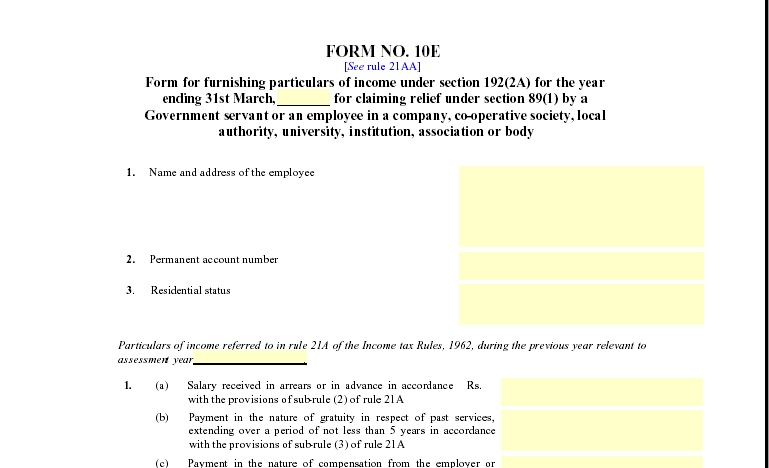
If you have ever received an unpaid salary from older years, you might have felt confused about why your tax suddenly shot up. Although arrears usually bring relief, they sometimes push you into a higher tax slab. Fortunately, Section 89(1) and Income Tax Form 10E let you claim relief, so you don’t end up paying extra tax unfairly. In this friendly, updated guide, we will walk through the Salary Arrears Relief Calculator U/s 89(1) for FY 2000-01 to FY 2025-26, ensuring you understand how everything works—clearly, smoothly, and confidently.
Just think of this tax relief as a “time machine” that lets the Income Tax Department calculate your tax based on the year your salary originally belonged to. Sounds easier, right? Let’s explore the complete process so that you can handle arrears like a pro.
Table of Contents
| Sr# | Headings |
| 1 | Introduction to Salary Arrears |
| 2 | What Is Section 89(1)? |
| 3 | Importance of Income Tax Form 10E |
| 4 | When Do You Need Salary Arrears Relief? |
| 5 | Understanding Arrears from FY 2000-01 to FY 2025-26 |
| 6 | How the U/s 89(1) Relief Calculation Works |
| 7 | Components Required for Calculation |
| 8 | Step-by-Step Guide to Using the Calculator |
| 9 | Example: Relief Calculation in Simple Words |
| 10 | Common Mistakes to Avoid |
| 11 | Benefits of Using the Updated Arrears Relief Calculator |
| 12 | Filing Form 10E Online – Complete Process |
| 13 | Documents Required for Form 10E |
| 14 | Updated Rules and Changes for FY 2025-26 |
| 15 | Conclusion and Final Thoughts |
1. Introduction to Salary Arrears
When your employer pays you pending salary from previous financial years, it is called salary arrears. Although it feels good to finally receive what you’re owed, arrears often increase your taxable income for the current year. Consequently, this may lead to a higher tax burden. Thankfully, Section 89(1) exists to protect you from unfair tax hikes.
2. What Is Section 89(1)?
Section 89(1) of the Income Tax Act helps employees reduce additional tax payable due to delayed salary payments. Since arrears don’t reflect your actual income pattern, Section 89(1) allows tax recalculation based on the years the income relates to. In short, it ensures fairness.
3. Importance of Income Tax Form 10E
To claim tax relief under Section 89(1), you must submit Income Tax Form 10E. Without filing this form, your refund can be rejected—even if the calculation is correct. Therefore, Form 10E is not optional; it is mandatory.
4. When Do You Need Salary Arrears Relief?
You need relief when:
- You received an unpaid or revised salary from earlier years
- Your employer paid DA, increment, or promotion differences
- A court or departmental order resulted in salary adjustments
Whenever arrears inflate your income unusually, relief becomes necessary.
5. Understanding Arrears from FY 2000-01 to FY 2025-26
Over 25+ years, salary structures, tax slabs, and financial rules have changed. Therefore, having a comprehensive and updated calculator covering FY 2000-01 to FY 2025-26 is extremely useful. It allows taxpayers to calculate relief no matter how old the arrears are.
6. How the U/s 89(1) Relief Calculation Works
Section 89(1) follows a clear formula:
- Calculate tax with arrears added to the current year.
- Calculate tax without arrears in the current year.
- Calculate tax for previous years with arrears.
- Calculate tax for previous years without arrears.
- Compare the differences.
- The excess amount becomes your relief.
This process ensures tax fairness—like comparing apples with apples.
7. Components Required for Calculation
To compute relief, you need:
- Arrear amount and year(s) it belongs to
- Salary of relevant years
- Tax slabs applicable in those years
- Current year salary details
- Deductions claimed in each year
Having accurate data ensures correct relief.
8. Step-by-Step Guide to Using the Calculator
A user-friendly calculator usually asks for:
Step 1: Enter arrear details year-wise
Step 2: Fill in the current year’s salary
Step 3: Add past year salaries
Step 4: Enter deductions (80C, HRA, etc.)
Step 5: Click “Calculate Relief”
Step 6: Download results for Form 10E
Using this updated calculator simplifies everything.
9. Example: Relief Calculation in Simple Words
Assume you received arrears of ₹1,00,000 for FY 2018-19.
Current Year Calculation
- Tax with arrears = Higher
- Tax without arrears = Lower
Difference = Extra tax due to arrears
Past Year Calculation
- Tax with arrears added to FY 2018-19 = Slightly higher
- Tax without arrears = Lower
Difference = Past year difference
If the current year difference > the past year difference, the remaining amount = Relief under Section 89(1).
10. Common Mistakes to Avoid
While filing for relief, avoid:
- Not filing Income Tax Form 10E
- Entering wrong financial year details
- Using incorrect tax slabs
- Forgetting deductions claimed earlier
- Skipping the arrear breakup
Accuracy is everything in arrears relief.
11. Benefits of Using the Updated Arrears Relief Calculator
This calculator helps you:
- Save time
- Avoid manual errors
- Access 25+ years of tax data
- Calculate relief instantly
- Generate Form 10E-ready values
- Get clarity and transparency
It is both convenient and dependable.
12. Filing Form 10E Online – Complete Process
Follow these steps:
- Log in to the Income Tax e-filing portal
- Go to e-File → Income Tax Forms → File Income Tax Forms
- Search for Form 10E
- Select Assessment Year
- Fill in arrear details
- Upload relief calculations
- Submit and verify
Your Form 10E will be successfully filed.
13. Documents Required for Form 10E
Keep the following ready:
- Salary slips
- Arrear statements
- Relief calculations
- Previous ITR copies
- Form 16
- Year-wise salary breakup
These documents ensure smooth and correct filing.
14. Updated Rules and Changes for FY 2025-26
Recent updates include:
- Revised tax slabs under both regimes
- Mandatory e-filing compliance
- Streamlined Form 10E structure
- Enhanced digital validation
- Faster refund processing
These improvements make the relief process more efficient.
15. Conclusion
Salary arrears often create sudden tax pressures, but with Section 89(1) and Income Tax Form 10E, you can easily claim the right relief. Whether your arrears date back to FY 2000-01 or FY 2025-26, the updated Salary Arrears Relief Calculator makes everything simpler, quicker, and more transparent. By understanding how this relief works and filing your Form 10E correctly, you can ensure that you never pay more tax than necessary.
FAQs
1. What is the purpose of Income Tax Form 10E?
Form 10E is required to claim relief under Section 89(1) for salary arrears or advance salary.
2. Can I get relief without filing Form 10E?
No. The Income Tax Department will reject your claim if Form 10E is not filed.
3. Do I need to submit supporting documents with Form 10E?
You don’t upload documents while filing, but you must keep them for records.
4. Is Section 89(1) relief available for pension arrears?
Yes, pension arrears also qualify for relief under this section.
5. How many years of arrears can be claimed under Section 89(1)?
There is no limit. You can claim relief for arrears from any past financial year, including FY 2000-01 to FY 2025-26.
Download Automated Income Tax Arrears Relief Calculator U/s 89(1) with Form 10E from the FY 2000-01 to FY 2025-26[Updated Version]
![Salary Arrears Relief Calculator U/s 89(1) with Form 10E from FY 2000-01 to FY 2025-26 [Updated Version]](https://apnataxplan.in/wp-content/uploads/2025/07/Govt-and-Non-Arrears-Relief-1.jpg)

