What Is Relief under Section 89(1)?
Section 89(1) allows taxpayers to reduce extra tax when they receive salary arrears, advance salary, or family pension arrears in a later financial year. In simple terms, this section protects you from paying higher tax only because you received income late. In other words, when arrears push your income into a higher tax slab, this relief corrects the imbalance. As a result, the law spreads the tax effect across the years to which the income truly belongs. Therefore, the relief removes the unfair tax burden caused by lump-sum payments. Ultimately, Section 89(1) ensures fairness, balance, and accuracy in tax computation.
Information Required Before Calculation
Before you begin the calculation, you must gather accurate information. First, you need the total arrears amount. Next, you must identify the exact year or years to which the arrears relate. Then, you should collect the original total income for each relevant year. After that, you must calculate the revised total income after adding arrears for each year. Finally, you need the tax payable, including Health and Education Cess, for all the years involved. Without these details, you cannot compute relief correctly. Hence, preparation becomes the most important step.
Step-by-Step Tax Arrears Relief Calculation u/s 89(1)
Step 1: Calculate Tax in the Year of Receipt (Including Arrears)
First of all, add the arrears amount to your current year’s total income. Then, compute the tax payable with arrears. Afterwards, compute the tax payable without arrears. Now, subtract the two amounts. As a result, the difference shows the additional tax due to arrears. Thus, this step identifies how much extra tax you paid because of lump-sum income.
Step 2: Calculate Tax for Each Relevant Past Year
Next, focus on each year to which the arrears belong. For every such year, add the respective arrears amount to that year’s income. Then, calculate tax with arrears. Meanwhile, calculate tax without arrears. Afterwards, subtract the two values. Consequently, you get the additional tax for that particular year. Similarly, repeat this process for all past years involved.
Step 3: Total the Additional Tax of Past Years
Now, add all the additional taxes calculated for previous years. At this stage, you get the total tax impact if arrears had been taxed in the correct years. Therefore, this total becomes crucial for relief computation. Ultimately, the relief equals the extra tax paid in the year of receipt minus this total.
Mandatory Requirement – Form 10E
Most importantly, you must file Form 10E to claim relief under Section 89(1). Specifically, you must submit Form 10E online through the Income Tax portal. Otherwise, the department will disallow the relief. Even if you calculate everything correctly, the system will still reject your claim without Form 10E. Hence, filing Form 10E is not optional. Instead, it is compulsory and unavoidable.
Important Points to Remember
Additionally, relief applies to salary arrears, advance salary, gratuity, commuted pension, and family pension. Moreover, the law allows this relief under both the Old Tax Regime and the New Tax Regime. Furthermore, you must include the Health and Education Cess while calculating tax. Likewise, you must always use the official slab rates applicable to each year. Otherwise, errors may occur. Therefore, accuracy remains essential.
Best Practice (Recommended)
To avoid mistakes, you should use an Automatic Income Tax Arrears Relief Calculator in Excel. Practically, such tools simplify complex calculations. Not only that, they save time. In addition, they reduce manual errors. Specifically, these tools automatically calculate year-wise tax. Moreover, they compute relief under Section 89(1). Besides that, they prepare Form 10E data. Finally, they show the impact on Form 16. Hence, automation delivers reliability and peace of mind.
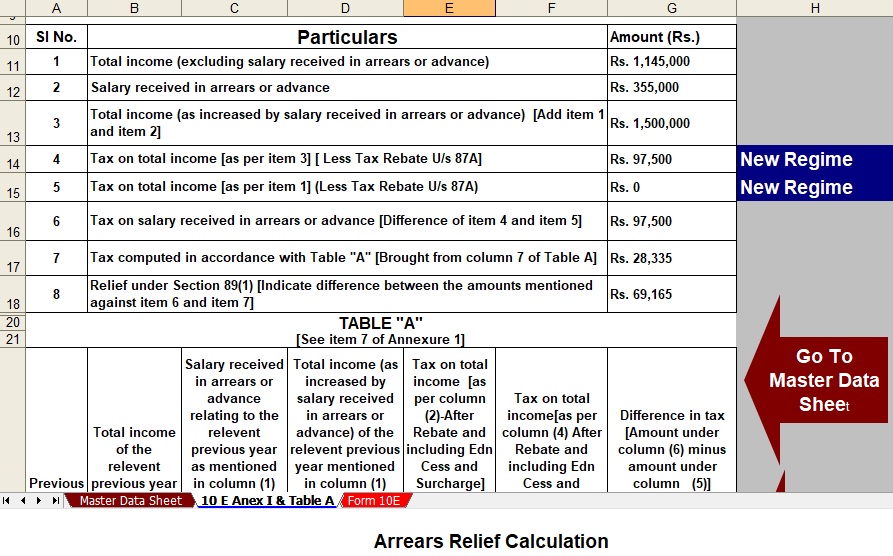
Automatic Tax Arrears Relief Calculator u/s 89(1) – How It Works (Excel Logic)
Typically, an Excel-based automatic calculator includes multiple sheets. Primarily, Sheet 1 captures basic details. Here, you enter the Assessment Year. Then, you select the employee type, whether Government or Non-Government. After that, you enter your PAN. Next, you fill in the current financial year’s total income. Finally, you input the arrears received year-wise. As a result, the calculator processes everything accurately.
Common Mistakes (Avoid These ❌)
Unfortunately, many taxpayers make avoidable errors. For example, they claim relief without filing Form 10E. Similarly, they use the wrong slab rates for past years. Additionally, they ignore cess. Worse still, they create mismatches between Form 10E and the ITR. Most critically, they file Form 10E after submitting the ITR. Therefore, you must avoid these mistakes at all costs.
Download Recommendation
In conclusion, you should download the Automatic Income Tax Arrears Relief Calculator u/s 89(1) with Form 10E in Excel for financial years from FY 2000-01 to FY 2025-26. By doing so, you ensure accuracy. At the same time, you maintain compliance. Ultimately, you save time, reduce stress, and maximise rightful tax relief.
Download Automatic Income Tax Arrears Relief Calculator U/s 89(1) with Form 10E in Excel from the FY 2000-01 to FY 2025-26