Introduction
Have you ever received salary arrears and felt confused about how to handle the tax calculation? Surprisingly, you’re not alone. Many taxpayers feel overwhelmed, yet Section 89(1) and Form 10E in Excel make the process much simpler—especially when supported by an Automatic Income Tax Arrears Relief Calculator that works from FY 2000-01 to FY 2025-26. Think of it like using a GPS instead of wandering through tax rules blindly. This guide helps you understand, download, and use the calculator with confidence.
Table of Contents
| Sr# | Headings |
| 1 | Understanding Income Tax Arrears |
| 2 | Why Section 89(1) Matters |
| 3 | What Is Form 10E and Why Do You Need It |
| 4 | Benefits of Using an Automatic Relief Calculator |
| 5 | Features of the Excel-Based Calculator |
| 6 | Step-by-Step Guide to Using the Calculator |
| 7 | Eligibility for Section 89(1) Relief |
| 8 | Common Mistakes to Avoid |
| 9 | Tips for Accurate Arrears Tax Filing |
| 10 | Download Process Explained |
| 11 | Safety and Data Protection Tips |
| 12 | Importance of Form 10E in Excel for E-Filing |
| 13 | How This Calculator Helps Salaried Employees |
| 14 | Comparison: Manual vs Automated Calculation |
| 15 | Final Thoughts on Efficient Tax Relief Filing |
1. Understanding Income Tax Arrears
Salary arrears arise when employers revise past payments, and they immediately influence your taxable income. Although the idea sounds simple, these arrears affect taxes differently because they link to older financial years. Consequently, your tax burden may appear higher; however, you can effectively reduce it when you use Section 89(1) relief. Moreover, this relief method ensures fair taxation even when your employer delays payments. Furthermore, it helps you adjust your tax liability year-wise. Hence, understanding arrears becomes essential for avoiding unnecessary tax loads.
2. Why Section 89(1) Matters
Section 89(1) actively helps taxpayers avoid paying extra tax due to delayed income receipts. Since arrears generally relate to previous years that may have had different tax slabs, this rule ensures fairness. Moreover, it adjusts your tax liability accurately so you don’t overpay. Additionally, it prevents tax distortion that arises because of timing differences. As a result, you benefit from correct year-wise calculations. Furthermore, Section 89(1) brings relief that you might otherwise miss. Therefore, this provision plays a crucial role in income tax compliance.
3. What Is Form 10E, and Why You Need It
Form 10E serves as a mandatory document when you claim relief under Section 89(1). When you fail to submit this form, the system may reject your relief claim even if you calculate everything correctly. Therefore, you must complete and submit Form 10E without delay. Moreover, using Form 10E in Excel simplifies the entire process and reduces error risks. Additionally, the Excel file helps you organise your data step-by-step. Consequently, your filing experience becomes smoother. Furthermore, it allows you to keep clean records for future reference.
4. Benefits of Using an Automatic Relief Calculator
An automatic arrears relief calculator saves time, reduces manual errors, and improves accuracy instantly. Additionally, it helps you visualise year-wise tax differences clearly, which becomes extremely helpful when handling long-pending arrears. Moreover, the calculator applies tax slabs automatically. Furthermore, it removes the confusion that often arises during manual calculations. Likewise, it simplifies data entry and enhances your confidence. Consequently, this tool becomes valuable for taxpayers who want reliable results. Hence, using an automatic calculator improves your tax filing experience overall.
5. Features of the Excel-Based Calculator
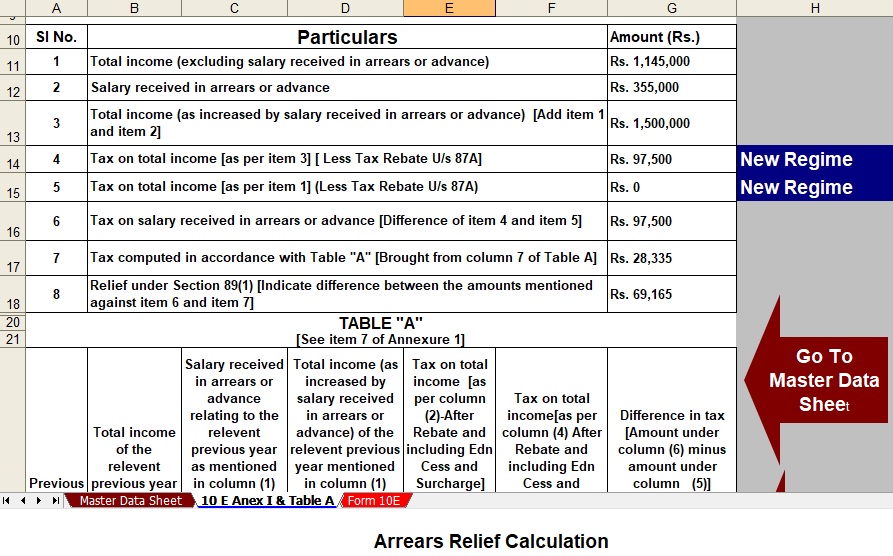
The Automatic Income Tax Arrears Relief Calculator U/s 89(1) includes several essential features:
- Pre-set formulas that calculate instantly
- Automatic tax slab application for each financial year
- Form 10E in Excel format for quick documentation
- Relief calculation from FY 2000-01 to FY 2025-26 effortlessly
- Easy print and save options for convenience
- Error-free active formula fields for accuracy
These features work together and make tax relief calculation easier than ever. Moreover, they streamline your workflow. Additionally, they eliminate time-consuming manual steps. Consequently, you get dependable results every time.
6. Step-by-Step Guide to Using the Calculator
To begin with, open the Excel file and enable macros if required. Next, enter your basic details, salary components, and arrear amounts for each relevant year. Afterwards, review the automatically generated tax computation shown in the sheet. Moreover, check the relief calculations year-wise. Furthermore, confirm that all entries match your salary documents. Finally, print or save your Form 10E and file it online. Consequently, your entire process becomes quick and seamless.
7. Eligibility for Section 89(1) Relief
You qualify for Section 89(1) relief when:
- You received salary arrears, advance salary, gratuity, pension, or commuted pension.
- Your arrears distort the tax slab of earlier years.
- You submit Form 10E in Excel or online.
Moreover, you must ensure that the arrears actually affect your earlier tax calculations. Additionally, you need to verify your documents before filing.
8. Common Mistakes to Avoid
Even though the calculator helps significantly, taxpayers commonly:
- Enter incorrect financial year details
- Skip filling Form 10E
- Miscalculate arrears year-wise
- Overlook older tax slab changes
However, you can avoid these mistakes by double-checking all entries. Moreover, careful verification ensures smoother tax computation. Additionally, it prevents last-minute corrections. Consequently, your filing becomes error-free.
9. Tips for Accurate Arrears Tax Filing
Always keep your salary slips, arrear statements, and Form 16 ready. Furthermore, double-check every figure and compare it with your employer-issued arrears summary. Moreover, calculate relief year-wise before filing. Additionally, use the Excel calculator because it reduces mistakes. Hence, your tax filing becomes more accurate. Consequently, you complete the process confidently.
10. Download Process Explained
Downloading the calculator remains extremely simple. Typically, you click the download link, save the Excel file, and open it in MS Excel. Additionally, you must ensure that your version supports formulas and macros. Moreover, you should verify the file source. Consequently, you protect your data while downloading.
11. Safety and Data Protection Tips
Since tax data contains sensitive information, always download tools only from verified sources. Additionally, avoid sharing your Excel file online or with unverified individuals. Moreover, keep your system updated for security. Furthermore, use password protection when saving files. Consequently, your financial data stays safe.
12. Importance of Form 10E in Excel for E-Filing
While filing your income tax return online, the portal may display a warning if you fail to submit Form 10E. Therefore, using a ready-to-use Form 10E in Excel helps you prepare the required details effortlessly. Moreover, it ensures that your relief claim gets accepted. Additionally, it prevents unnecessary delays. Consequently, your e-filing experience improves significantly.
13. How This Calculator Helps Salaried Employees
Salaried employees frequently face pay revisions, promotions, or DA increases. Hence, arrears become common for them. Moreover, this calculator simplifies the entire relief process, allowing employees to calculate and claim benefits confidently. Additionally, it guides them through year-wise computations. Furthermore, it reduces errors that often occur with manual calculations. Consequently, employees get accurate relief results.
14. Comparison: Manual vs Automated Calculation
Manual calculation consumes time, creates confusion, and increases error possibilities. On the other hand, automated computation gives accurate results instantly. Moreover, it applies tax slabs correctly for each specific year. Additionally, it saves effort and prevents miscalculations. Furthermore, automation improves consistency. Consequently, most taxpayers prefer automated tools for reliable outcomes.
15. Final Thoughts on Efficient Tax Relief Filing
To sum up, using the Automatic Income Tax Arrears Relief Calculator U/s 89(1) with Form 10E in Excel makes tax filing faster, simpler, and far more accurate. Moreover, the tool works like a dependable assistant and prevents unnecessary tax burdens. Additionally, it ensures long-term accuracy. Consequently, you file taxes confidently and efficiently.
FAQs
1. What is the purpose of Form 10E in Excel?
Form 10E in Excel helps taxpayers prepare and submit the required details for Section 89(1) relief accurately.
2. Do I need to file Form 10E before filing my ITR?
Yes. The Income Tax Department clearly recommends filing Form 10E before submitting your return.
3. Can this calculator be used for older financial years?
Absolutely. It supports arrears calculations from FY 2000-01 onward.
4. Is the calculator suitable for both government and private employees?
Yes, it works effectively for all salaried individuals receiving arrears.
5. Is Section 89(1) relief automatically granted?
No. You must file Form 10E and calculate the relief properly using tools like this Excel calculator.
Download the Automatic Income Tax Arrears Relief Calculator U/s 89(1) with Form 10E from the FY 2000-01 to FY 2025-266
Download the Automatic Income Tax Arrears Relief Calculator U/s 89(1) with Form 10E from the FY 2000-01 to FY 2025-26