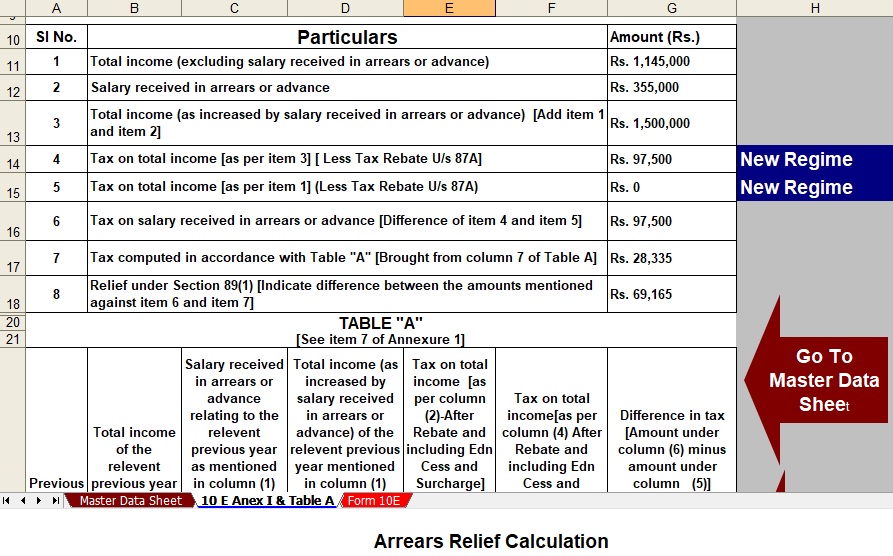
Everyone wants to save tax, and when arrears suddenly enter your salary slip, the tax burden often rises quickly. However, with the Automatic Arrears Relief Calculator U/s 89(1) and Income Tax Form 10E, you can calculate relief smoothly, accurately, and confidently. Although tax laws may seem complex, this tool simplifies the entire journey. Interestingly, it feels like having a personal tax assistant in your laptop that guides you step-by-step.
Table of Contents
| Sr# | Headings |
| 1 | Introduction to Arrears Relief |
| 2 | Understanding Section 89(1) |
| 3 | Role of Income Tax Form 10E |
| 4 | Why Arrears Increase Tax Burden |
| 5 | Benefits of Using an Automatic Calculator |
| 6 | Step-by-Step Process |
| 7 | Documents Required |
| 8 | Example of Relief Calculation |
| 9 | Filing Form 10E Online |
| 10 | Tips for Accurate Filing |
| 11 | New Tax Regime vs Old Tax Regime |
| 12 | Common Mistakes to Avoid |
| 13 | Importance for FY 2025–26 |
| 14 | Who Should Use It |
| 15 | Final Conclusion |
Introduction to Arrears Relief
When you receive salary arrears, you often pay tax at a higher slab. Therefore, the government introduced Section 89(1). Although arrears belong to past years, they get taxed in the current year. Therefore, Consequently, this creates an unfair tax load. Therefore, arrears relief helps you balance tax across years correctly, and so you get tax savings quickly.
However, Understanding Section 89(1)
Section 89(1) provides relief from additional tax that arises due to arrears. Since arrears change your income suddenly, the section ensures fair taxation. Because of this, the excess tax paid due to arrears can be claimed back. In other words, Likewise, it allows you to calculate past year income with arrears, compare it with current year income, and receive the difference as relief.
Role of Income Tax Form 10E
To claim relief, you must submit Income Tax Form 10E. Without Form 10E, your relief claim may be rejected. Therefore, the form works like proof of calculation. Because of this requirement, the Automatic Arrears Relief Calculator includes Form 10E details, making the process easier. Accordingly, you can calculate and upload the data online in a few minutes.
Why Arrears Increase Tax Burden
Arrears add income to your current year’s salary. Consequently, your income may shift to a higher tax slab. Therefore, tax payable increases. Yet, you didn’t earn that money this year, since it belongs to past periods. Hence, Section 89(1) helps you distribute the arrears over the original earning years, and so reduces tax liability.
Benefits of Using an Automatic Calculator
Using the Automatic Arrears Relief Calculator gives many benefits:
- Accuracy in calculations
- Speed compared to manual work
- Automatic Form 10E generation
- Transparency, as every step is visible
- Reduced errors in tax filing
Also, because the calculator follows tax rules automatically, you do not miss any deductions. Moreover, the tool saves time and effort, especially when arrears are spread over multiple years.
Step-by-Step Process
Although it looks technical, the process is simple:
- Enter salary details year-wise.
- Enter arrears amount for each year.
- Check tax calculation for each year.
- Compare tax difference.
- Claim relief under Section 89(1).
- Generate Income Tax Form 10E.
- File the form on the portal.
Thus, you move through the process smoothly and finally enjoy tax benefits.
Documents Required
Before using the calculator, gather:
- Salary slips
- Form 16
- Arrears breakup
- PAN details
- Previous tax returns
Because you have complete data, the calculator becomes accurate, and therefore, you avoid mistakes.
Example of Relief Calculation
Imagine you received arrears of ₹1,00,000 in FY 2025–26 related to FY 2022–23. Normally, this amount pushes your tax into a higher slab. However, using the calculator distributes the amount into FY 2022–23. Consequently, tax burden reduces, and the relief returns to you.
Filing Form 10E Online
To file Income Tax Form 10E:
- Log in to the portal
- Select e-File
- Choose Income Tax Forms
- Submit Form 10E
- Upload the details
Hence, the relief gets approved automatically. Therefore, filing before the return submission is important.
Tips for Accurate Filing
To avoid rejection, follow these tips:
- Always upload Form 10E before ITR
- Check the calculation twice
- Keep salary proof ready
- Update portal details
- Use the latest calculator
Thus, filing becomes smooth, and you receive tax benefits faster.
New Tax Regime vs Old Tax Regime
Relief applies under both regimes. However, the old regime offers more deductions. Consequently, some employees choose it. Yet, under the new regime, rates are lower. Therefore, compare both regimes before filing Income Tax Form 10E, and then choose the best option.
Common Mistakes to Avoid
People often make mistakes like:
- Not filing Form 10E
- Incorrect income breakup
- Missing arrears year details
- Using an outdated calculator
- Submitting wrong data
Although these errors look minor, they delay relief. Therefore, stay careful while entering data.
Importance for FY 2025–26
FY 2025–26 includes new taxpayers under the universal tax system. Therefore, many will receive pending salary revisions due to new pay structures. Consequently, arrears relief becomes important. Additionally, digital tools make tax filing easier. Hence, using an Automatic Calculator gives confidence.
Who Should Use It
If you received arrears due to:
- Pay commission revisions
- Promotion
- Bonus settlement
- Pay correction
- Increment delay
Then you should use the calculator and file Income Tax Form 10E.
Conclusion
In conclusion, the Automatic Arrears Relief Calculator U/s 89(1) with Income Tax Form 10E makes tax relief easy and quick. Because it saves time, reduces mistakes, and ensures fair relief, everyone should use it. Although taxes appear complicated, digital tools make it simple. So, why pay more tax when the law gives you relief?
FAQs
- What is Income Tax Form 10E?
It is a form used to claim arrears relief under Section 89(1). - Can I claim relief without filing Form 10E?
No, without Form 10E, relief may not be allowed. - Who can use the arrears relief calculator?
Anyone who received salary arrears for previous years. - When should I file Form 10E?
You should file it before filing your Income Tax Return. - Does relief apply under the new tax regime?
Yes, arrears relief under Section 89(1) applies under both regimes.
Download Automatic Income Tax Arrears Relief Calculator U/s 89(1) with Form 10E from the FY 2000-01 to FY 2025-26